

Archive for the ‘Media’ Category
#Asaincepe
vineri, iunie 27th, 2014The 5 main insights at a glance:
1. One-third of journalists said social media posts are not a reliable source of information. Despite this, half of journalists said social media were their main source of information.
2. Remarkably, half of journalists said they consider consumer opinion to be more reliable than a statement by an organisation. Journalists use social media to find out what people are talking about and when writing articles, but do not always check whether public opinion is based on facts.
3. Fact-checking has become less thorough; ‘publish first, correct if necessary’ is the motto these days. Only 20% of journalists always check their facts before publishing. Almost half of journalists said they published most of their stories as quickly as possible to correct later if necessary. PR professionals also noted that since the arrival of social media journalists are getting in contact less frequently to check facts.
4. Journalists (60%) said they feel less bound by journalistic rules on social media than with traditional media such as a newspaper article. They act differently on social media than in traditional media, sharing their personal opinion more openly on social media, despite the fact that journalists are seen as being objective and reporters of news facts relating to events of general importance.
5. Dutch PR professionals are lagging behind compared to their international counterparts. In the Netherlands the focus lies on sending out news, while internationally more attention is devoted to dialogue and direct contact with journalists and consumers via social media.
The 5 main expectations for the future
1. Journalists expect less fact-checking to be done in the future. Conversely the role of crowd-checking, whereby the public’s opinion is used and accepted as being true, will grow in importance.
2. User-generated content, such as tweets and pictures or videos from bystanders, is already widely used in news and is expected to grow further.
3. Dutch PR professionals will stage a catch-up as they reduce their focus on sending out releases and concentrate more on engaging in dialogue and building relations.
4. Journalists expect journalism to be driven by clicks and views more than by content.
5. PR professionals expect their contact with consumers to intensify with increasingly less involvement of journalists, now that they have the ability to approach the target group directly and engage in dialogue with them.
Publish first, correct later if necessary
With 45% of journalists putting out 60% to 100% of what they publish as soon as possible – without checking facts – and correct later if necessary, “publish first and correct later” seems to be the new motto.
Newspapers vs Internet publishing
marți, iunie 10th, 2014
A tale of two technologies. Newspaper vs internet publishing. Taken from this amazing graphic http://t.co/u1lteYBkXx pic.twitter.com/YXlkLEego1
— Henry Taylor (@henryctaylor) June 5, 2014
Trei despre ICEEfest
vineri, iunie 6th, 2014Zilele trecute ma intreba un coleg: Cum a reusit Stanca sa aduca atatia invitati la ICEEfest? Chiar, cum ai reusit Dragos? Peste 70 de speakeri pe scena dintre care cred ca peste 50 de la companii si playeri importanti in jocul global si/sau regional.
De ce vreau sa ajung?
1. Facebook, Google, Yahoo, Shazam, BBC, Forbes, AppNexus, Sid Lee, Zoo, DigitasLBi etc. Companii si playeri importanti care apar la mari evenimente de genul acesta din Europa si US, merita vazuti si „evaluati” live aici, la Bucuresti.
2. Combinatia de teme (pe langa clasicele prezentari mai mult sau mai putin „conventionale” ale „greilor”) e interesanta: content (BBC, Forbes, Spiegel Digital, UpComing), e-commerce si performance marketing (vad ca eMag e si sponsor, interesant) unde Facebook si Google si-au trimis oameni care vorbesc dedicat despre asta, „isteria” cu programmatic buying si RTB (mai toate agentiile majore s-au inghesuit la tema lor favorita, in doua ture, pe ambele scene si in ambele zile: AppNexus, Cadreon, Xaxis, Mindshare, DataXu, LiveRail etc) plus partea ceva mai digerabila, de creatie si branded content (nume interesante acolo, de la agentia de creatie a Google, Zoo, pana la Sid Lee, Achtung, DigitasLBi si altii care apar des pe la Cannes)
3. Desi nu ma omor dupa fun :) se pare ca va fi si asa ceva pe scena si in jurul ei cata vreme e cu stand-up comedy made in UK si vedete care vorbesc despre Internet – interesant de vazul Grasu XXL plus Andi Moisescu cu Bendeac, Gheba si Bobonete despre viralele anului.
PS Si da, Mediafax Group e partener, ca si anul trecut, ZF live va fi acolo pentru interviuri cu speakeri si invitati interesanti si aveti din nou un super deal: la orice bilet cumparat full price primiti Ziarul Financiar si Business Magazin timp de un an.
PS 2 Joi si vineri saptamana viitoare, agenda completa aici
PS 3 NU AM INVITATII :)
Piata scade, pietrele raman
miercuri, mai 28th, 2014În 2013, companiile au cheltuit circa 24 de milioane de euro pentru a-?i face reclam? prin intermediul Google ?i Facebook, iar pentru anul acesta se estimeaz? o cre?tere de 25%, în timp ce bugetele alocate pentru publisherii locali din mediul online s-au situat la 22 de milioane de euro, urmând ca acestea s? scad? cu 10% în 2014, conform calculelor ZF bazate pe datele furnizate de Initiative Media în studiul Media Fact Book pe 2014.
„În ceea ce prive?te bugetele investite în zona digital?, valoarea acestora a crescut cu 12% în 2013, ajungându-se la 46,2 milioane de euro. Este un trend de cre?tere care se men?ine de câ?iva ani, din 2011 digitalul fiind al doilea mediu în mixul de comunicare în pia?a local?“, a spus Raluca Mateescu, integrated and digital media director în cadrul agen?iei BPN, parte a grupului Interpublic care include ?i Initiative Media.
„Zona de display (publisheri locali cu con?inut premium – n. red.) a fost constant? în 2013 comparativ cu 2012, acesta fiind primul an în care nu s-a înregistrat o cre?tere pe acest segment. Astfel, zona de display a avut anul trecut o pondere de 48% în totalul bugetelor alocate publicit??ii în mediul online. Ponderi în cre?tere (din bugetele de publicitate – n. red.) au primit platformele de pay per click – agen?iile media au început s? î?i doreasc? mai mult s? intre în zona aceasta, iar Google, Facebook ?i Yahoo acumuleaz? bugete tot mai mari de aici“, a explicat ea.
De aici, articol sub paywall
1 cu 4
miercuri, mai 21st, 2014Desi nu sunt de acord cu (tot) ce a scris Catalin Tolontan astazi, am retinut ca:
Prima c?dere a fost din print în online. A doua va fi din online în google. Calculele arat? astfel. Iei 40.000 de euro pe lun? din publicitatea online, ceea ce se întîmpl? unui num?r mic de redac?ii. În schimb, din google încasezi 10.000 pe lun?. Simbolic calculînd, pentru fiecare patru euro pierdu?i din publicitatea de agen?ii prime?ti o compensa?ie de un euro adus de google. Este exemplul unor publica?ii de talie mare.
Trebuie remarcat ca gsp.ro este un site plin de coduri Google, implicit de reclame furnizate de Google. Intregul post, care face parte dintr-un „serial” de trei, il gasiti aici.
Ultimii
miercuri, mai 21st, 2014Dar si cu cel mai mare potential de crestere :)
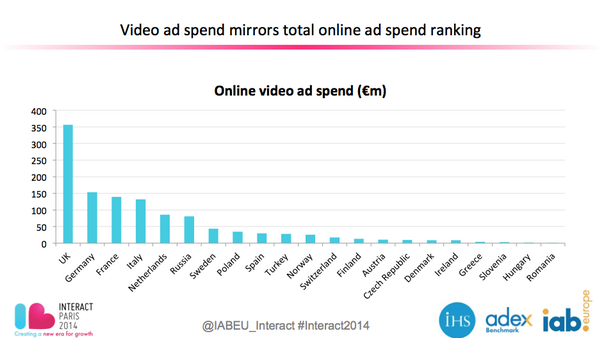
Altfel, toata piata de online advertising in Europa a totalizat 27.3 miliarde Euro, in crestere cu 11.9%. Not bad.
The New York Times Innovation Report
vineri, mai 16th, 2014In the coming years The New York Times needs to accelerate this transition from a newspaper that also produces a rich and impressive digital report to a digital publication that also produces a rich and impressive newspaper. This is not a matter of semantics. It is a critical difficult and at times painful transformation that will require us to rethink much what we do every day.
Our leaders know this and we have taken steps in these directions. But it has become increasingly clear that we are not moving with enough urgency. This may be the single most important long-term challenge facing the newsroom and its leaders.
There are factors that, understandably, slow this tricky transition. More than three quarters of our advertising and subscription revenue still comes from the newspaper, and most of our employees have spent their careers building skills to succeed in print. But the huge majority of our readers are digital, and this represents our single biggest opportunity for growth.
As a business, this is an extremely difficult balancing act. It is just as tricky for the newsroom. The experience of putting out the newspaper informs almost every element of how we do our jobs, from the people we hire to how they work to what they produce. These assumptions — based on the newspaper’s fixed dimensions and hard deadlines — are so baked into our days that it is easy to overlook their artificial limitations or the new possibilities we could embrace.
De aici
Zece de la Martin Sorrell
marți, mai 13th, 2014Martin Sorrell la congresul IAA, din China:
1. Shift to East, South and South East – meaning a potential shift in power in the world. The USA is still the center, but undeniably power is beginning to move. With a focus still on „BRICS and the next eleven”. WPP sees a G2 world in the future.
2. Overcapacity and shortage of human capital – in key industries such as automotive there is massive capacity, but changing life styles, and aging populations.
3. Rise and rise of the web – 12 years ago WPP’s web business was close to zero and now it is 30%.
4. Growth of retail power – and the changing relationship now between retailers and consumers as populations move to urban areas, with busy two earning families using the e-commerce more and more.
5. Importance of internal communications – data – people talk about „data” and we are now applying more technology to data and its role in our organization’s communications.
6. Global and local structures – WPP sees the rise of Africa – which represents significant opportunities with a dramatic shift in power taking place.
7. Relative power of finance and procurement – the balance of marketing functions and finance is now very much out of balance, and this needs to be addressed – in all parts of the world. Not just the western economies.
8. Growth of government – WPP has government clients in almost every country. They are more significant players than ever. In some parts of the world, such as China, there is also an element of „Government run capitalism”.
9. The acceptance of social responsibility – the issue and attention towards sustainability is considerable now. And for companies to „do good” is still „good” for business.
10. Industry consolidation – this was a big news day with the announcement that the Publicis Groupe and Omnicom Group merger is not proceeding.
Stirea noptii
vineri, mai 9th, 2014The ad giants Omnicom Group and Publicis Groupe called off their $35 billion merger on Thursday, bringing a premature end to a deal that would have created the largest advertising company in the world.
De aici
Okazii.ro = 2 milioane euro/an venituri
marți, mai 6th, 2014Astazi la ZF Live la a fost Siminel Andrei, managerul NCH Romania care detine, printre altele, mai multe proprietati online: Okazii.ro, Imobiliare.ro, Ziare.com, Cinemagia.ro, Eva.ro, Sentimente.ro, Myjob.ro etc.
Extrem de deschis, cine-l cunoaste* stie ca este extrem de discret, Siminel i-a dat colegului Fini mai multe detalii/date despre business-urile online detinute de NCH. Sumarizez:
– Okazii este un business de 2 milioane euro/an venituri
– Au avut oferta mai mare de 10 milioane euro pentru Okazii
– Imobiliare.ro are venituri de 2 milioane euro/an
– Sentimente are venituri de aproape 400,000 euro/an
– SfatulMedicului.ro are venituri de 300,000 euro/an
Inregistrarea interviului o gasiti aici.
* Am lucrat pentru Netbridge, parte din NCH, si implicit cu Siminel Andrei, din 2001 pana in 2006.